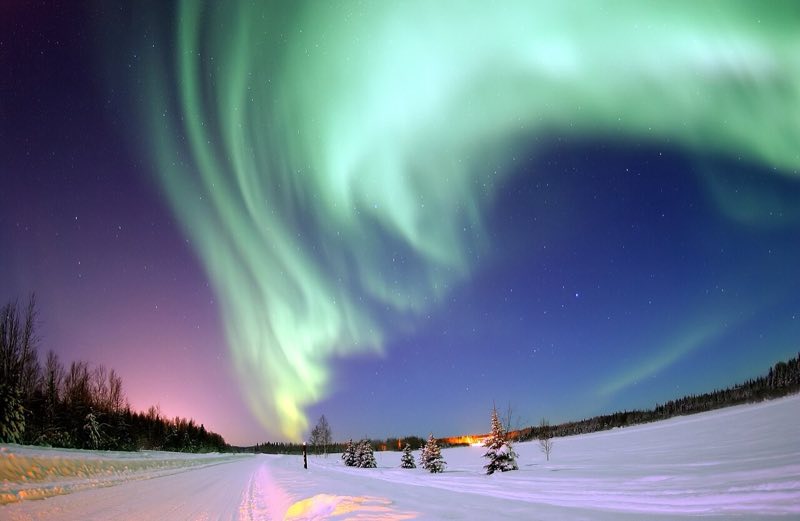
Photo: United States Air Force photo by Senior Airman Joshua Strang · Public domain
Aurora
An aurora is light in the night sky near the poles. It appears when charged particles, driven by the wind from the sun, strike gas high in the atmosphere.
- Usual colour
- Green, from oxygen, 557.7 nm
- Height
- Mostly 100 to 300 km
- Where
- Ovals around the magnetic poles
Where the light comes from
The sun sheds a constant wind of charged particles. The Earth’s magnetic field turns most of it aside, but energy from the wind builds up in the field and is released toward the poles, driving electrons down along magnetic field lines. When they hit oxygen and nitrogen, the gas glows, as in a neon sign.
Why the colours differ
Each gas gives its own colours, and height decides which appear. Oxygen gives green lower down and a slow deep red higher up. Nitrogen adds blue and purple, often along the lower edge of a curtain.
Storms
After large eruptions on the sun, the ovals widen toward the equator. During the Carrington Event of 1859, auroras were reported from the Caribbean and Hawaii, and telegraph systems failed across Europe and North America. It is glowing gas, unlike bioluminescence, which is made by living things.