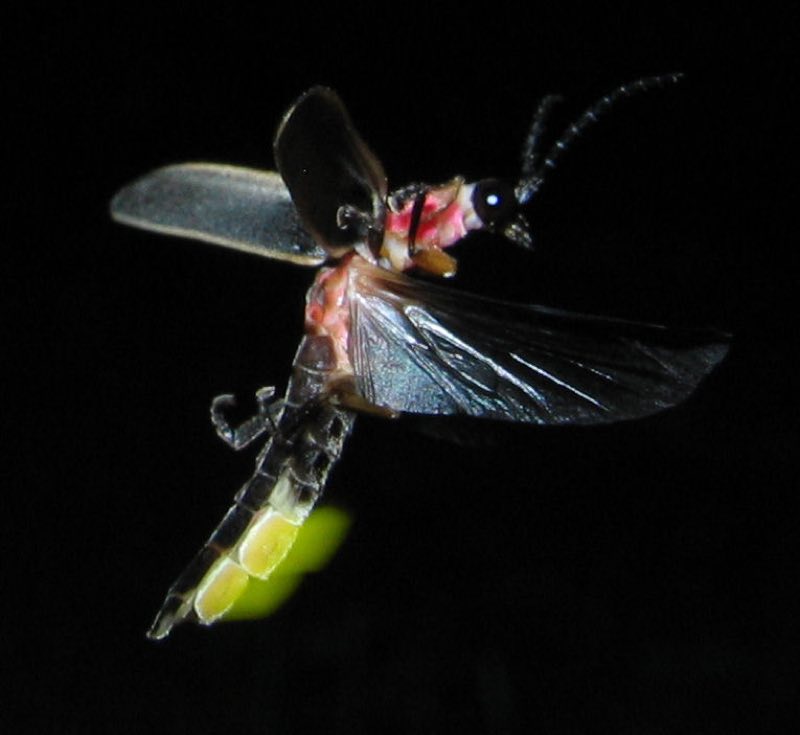
Photo: art farmer from evansville indiana, usa · CC BY-SA 2.0
Bioluminescence
Bioluminescence is light made by living things. A chemical reaction inside the organism releases its energy as visible light, with very little heat.
- Reaction
- Luciferin and oxygen, driven by luciferase
- Usual colour in the sea
- Blue-green, 470 to 490 nm
- Made by
- Bacteria, fungi, jellyfish, squid, fish, fireflies
Chemistry
The molecule that gives off the light is called a luciferin, and the enzyme that drives the reaction is a luciferase. The names describe roles, not single substances: fireflies use one luciferin, many sea animals another. When luciferin reacts with oxygen, the product sheds its extra energy as a photon.
Where it occurs
On land it is rare: fireflies, glow-worms, some beetles and about a hundred kinds of fungi. In the open ocean it is the rule. Single-celled dinoflagellates flash when the water around them is disturbed, so breaking waves can glow at night. It should not be confused with an aurora, which is glowing gas.
Use by people
The firefly reaction needs ATP, which every living cell contains, so firefly luciferase is used to test surfaces for contamination: more light means more living material. A jellyfish gave biology green fluorescent protein, whose development won the Nobel Prize in Chemistry in 2008.