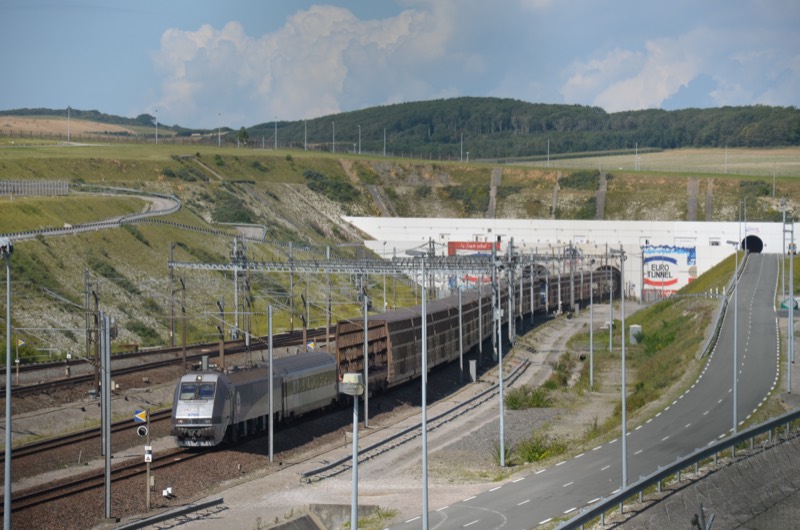
Photo: Florian Fèvre · CC BY-SA 4.0
Channel Tunnel
The Channel Tunnel carries trains between Folkestone in England and Coquelles in France. Opened in 1994, it has the longest undersea stretch of any tunnel in the world. Private investors paid for it, and the bill ran far over budget.
- Length
- 50.46 km, of which 37.9 km under the sea
- Opened
- 6 May 1994
- Cost
- £4.65 billion in 1985 prices, 80% over budget
Two centuries of plans
People dreamed of a tunnel long before anyone could build one. In 1802 the French engineer Albert Mathieu-Favier proposed one. In 1881 a company began digging from both coasts, but Britain stopped the work in 1883 because its military feared an invasion route. A joint British and French scheme started in 1974, then Britain's government cancelled it in January 1975. The Treaty of Canterbury, signed in February 1986, finally cleared the way.
Digging under the sea
Work began in December 1987. Eleven tunnel boring machines chewed through a soft rock called chalk marl from both sides. On 1 December 1990 the British and French teams met in the service tunnel. At the peak about 15,000 people worked on the project, and ten workers died between 1987 and 1993, eight of them British. Queen Elizabeth II and President François Mitterrand opened the tunnel on 6 May 1994.
Three tunnels, not one
The tunnel is really three tubes. Two carry trains, one in each direction, on a single track each. A smaller service tunnel runs between them for maintenance and escape. On average the tubes run 45 metres below the seabed. At their lowest point, about 13 km offshore, they sit 115 metres below sea level, under 75 metres of rock. Trains are allowed up to 160 km/h inside. Eurostar runs passenger trains, LeShuttle carries cars and lorries, and freight companies run cargo trains. Getlink, once called Eurotunnel, owns and runs it.
Paid for by private money
Governments agreed to the tunnel but refused to pay for it. Eurotunnel raised the money itself, with a public share offer of £770 million and a huge bank loan. It is a classic case of project finance: lenders were to be repaid from the tunnel's own future fares under a concession. The concession was first set at 55 years, extended to 65 in 1993, and extended again in December 1997 by 34 years, to 2086. The final cost came in 80% over budget, and financing costs were 140% above forecast. Debt crushed the company until a Paris court approved a rescue plan on 15 January 2007. The new Groupe Eurotunnel listed its shares on 2 July 2007.